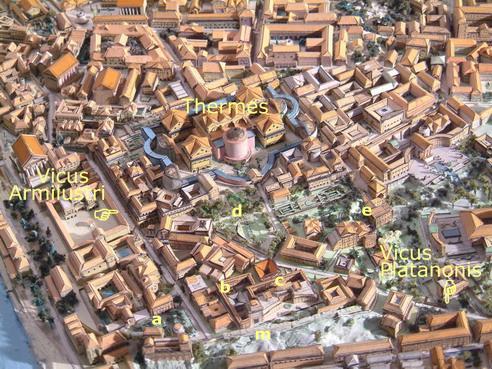
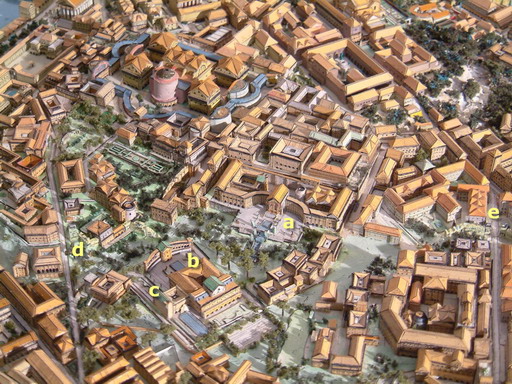
The southern part of the Sub-Aventine housed as well splendid mansions, among which the most important seemed to be that of
Valérius Potitus a,
who was probably one the numerous consuls of the Valerii family during the imperial period.
The second domus to be noted is the
Æmilii House b.
The Æmilii, or Gens Æmilia, constitute one of the most important families of the Roman history.
Next to the Æmilii House here is the
Suetrius Sabrinus’ House,
c,
consul in 214. The old Servian wall that ran around the Aventine at the time of its building
let see under Constantine whole sections still standing or half collapsed, among which the
porta Laverna ,
d (
porta Lavernalis)
with only one intact gate that still mounts guard on the slope of the Vicus Platanonis.
Going across the Vicus Portæ Raudusculanæ, the gate
Porta Raudusculana
e (
Porta Raudusculana),
of which the adjacent walls are fairly damaged.

The Sub-Aventine plain was crossed by the Via Ostiensis
that linked the banks of the Tiber with the Ostiensis Gate.
That was therefore an important way of communication. For the contemporaries,
the Via Ostiensis surely seemed humming with activity due to all these nearby
warehouses since these certainly generated a permanent traffic. Nevertheless
some insulæ (they were everywhere in Rome) stood close to these warehouses,
as well as an important Domus, the House and gardens of Aurelius Cotta
on the right side of the via Ostiensis. Was he the Consul who in 75 was one of most brilliant
speakers of his time according to Cicero (Brutus § 202-210)? We are not sure, but if it was him,
he would then be Cæsar’s maternal uncle. Left of the Via Ostiensis and half-way to the
Testaceus Mount, two funeral steles lightened the heaviness of the buildings.
The pomœrial stele of Claudius
and that of Vespasian (which is out of the range of the model).
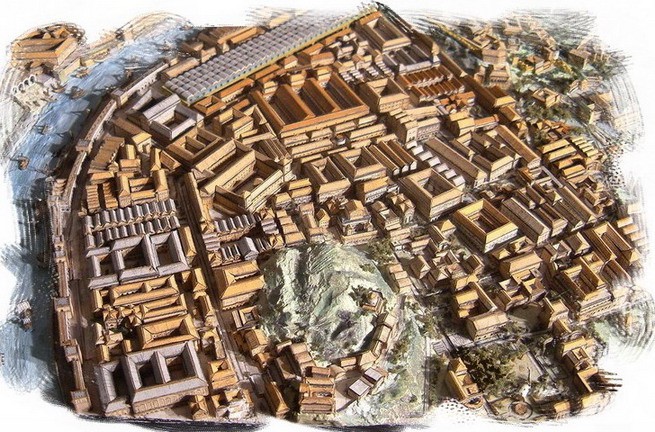
Close to the great warehouse porticoes and the Tiber stood a hillock called
Testaceus,
that would have been artificially formed during the Empire by piling up
the splinters of amphoras coming from the harbours along the river.
This mound appears at the bottom of the picture, in the bend of the Tiber.
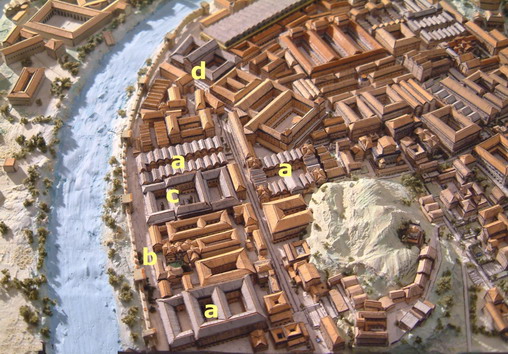
The quadrilateral between the Tiber, left, the Testaceus Mount, right, and the Porticus Æmelia
at the top of the picture, was practically entirely covered with warehouses (a)
in order to store all the goods that arrived through the harbour of Ostia. The best identified warehouses are those of Lollius (c) ( Horrea Lolliana )
and those of Seius (d) ( Horrea Seiana ). Last, some baths (b),
as they were so many in Rome, were to be found even in this commercial district.